Overview
The Oracle reimagines fortune-telling for a digital context. Users encounter a pentagon-shaped device, choose a path, and receive a reading manifested as a unique abstract 3D transformation—hypnotic, symbolic, and open to interpretation.
The experience was designed as a short, ritual-like moment: intentional pacing, restrained UI, and a strong visual reveal. The end result is a cinematic interaction that feels more like a performance than a utility.
Context & Opportunity
Most fortune apps are text-heavy and literal. I wanted to create a tactile, mood-first experience where meaning is discovered rather than explained.
The opportunity was to invent a language of motion and form that could act as a personal “reading” without relying on written fortune copy.
“Anticipation → Choice → Reveal → Reflection.”
Device & Character
The Oracle lives in a small handheld pentagon — a tactile object you hold, press, and turn to receive a reading. The hardware vocabulary borrows from the Magic 8 Ball, the Nintendo Switch, and a charcoal jewelry box: familiar enough to invite play, strange enough to feel ceremonial.
The character behind the device is simple: The Oracle is a sentient being who advises mankind. Two top buttons handle navigation and selection; everything else happens on-screen.
- Dimensions
- 3 × 3 inches
- Screen
- 448 × 427 px
- Controls
- 2 top buttons (select + on)
- Inspiration
- Magic 8 Ball · Nintendo Switch · Charcoal Box
- Character
- The Oracle is a sentient being who advises mankind.

Site Map
The product fans out from a single entry point into five elemental paths. Each path resolves the same way — a reading, then quit — so the structure stays legible no matter which element a user picks.
Off → Intro → Start branches into the five elements; each element carries its own base state, animation, and reading. A persistent Quit returns the device to rest.

Intro Screens
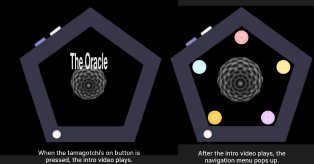
Pressing the on button plays an intro video that introduces The Oracle as a presence, not a product. The navigation menu only appears once the video resolves — anticipation is part of the ritual.
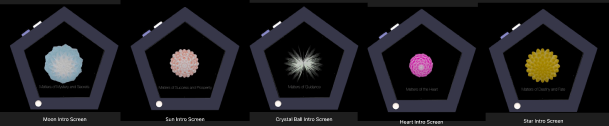
From the menu the user chooses one of five elements: Moon, Sun, Crystal Ball, Heart, or Star. Each has its own intro screen with a short matter — matters of intuition, matters of clarity, matters of guidance, matters of the heart, matters of destiny.
- Moon · Intuition
- Sun · Clarity
- Crystal Ball · Guidance
- Heart · The Heart
- Star · Destiny
User Flow
The flow narrows toward a single moment of reveal. Minimal UI, strong pacing, and a clear end state give space for interpretation.
Anticipation builds through the intro and selection screens; the reveal is a slow, breathing 3D transformation; quit returns the device to its waiting state — ready to be picked up again.

Possible Responses & Visuals
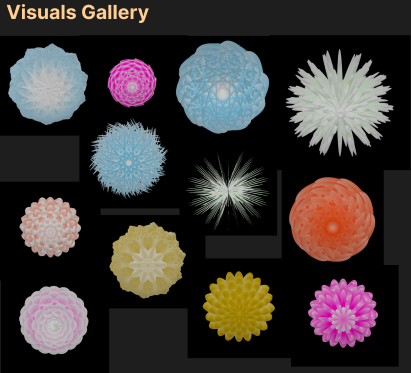
Each element resolves to one of two visual options — ten total readings. The animation is the message: a unique 3D form blooms inside the pentagon, holds, and softens out.
Two options per element keep readings feeling personal without becoming literal. Forms range from soft floral silhouettes to spiked star bursts, each tuned for its element's tone.


Visuals Gallery
Form exploration focused on organic abstraction, hypnotic motion, and contrast between readings. Each visual is designed to feel alive but legible against the device's inky pentagon.
The palette leans on luminous highlights against black so attention falls on silhouette and movement, not literal iconography.
Process Work
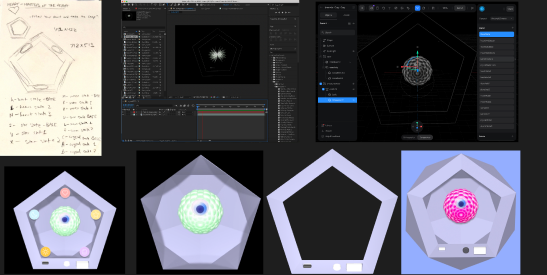
The device, character, and response language came out of sketching, motion tests in After Effects, and 3D form exploration in Cinema 4D. The pentagon was the anchor — everything else grew around it.
A second prototype iteration tightened the connections between intro, navigation, and each element's base state, so the flow could be tested end-to-end before committing to final motion.

Outcome
A compact, cinematic reading experience that merges UI, 3D, and motion—demonstrating multi-tool fluency and strong art direction.
The prototype is ready for a real-time generative expansion with voice or touch input, and a growing “library” of readings that evolve with each session.
Next Steps
Future iterations focus on personalization, spatial audio, and richer input modalities that deepen the ritual.
More interactive experiments and product work ↓